TrainingRanker
Menu

Review

THERABAND FlexBar Review

The THERABAND FlexBar is a compact rubber resistance bar designed for grip, wrist, forearm, and elbow-focused exercise. It stands out as a simple, highly portable tool for home therapy-style routines and light upper-extremity training. Its main limitation is that the green medium version is fairly specialized and may be too strong for some users starting out.
Expert reviewed
90
Overall score
Data-driven scoring Expert reviewed Updated analysis

Why we ranked it highly

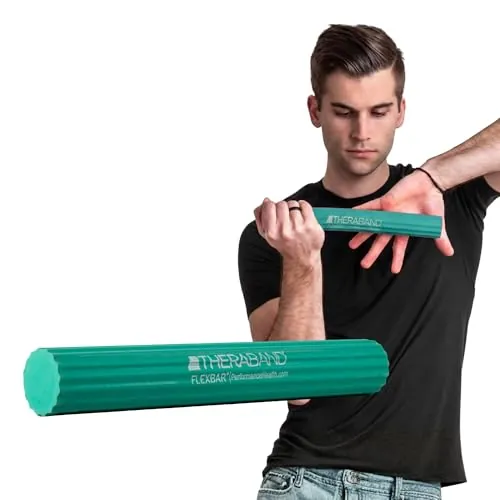
The THERABAND FlexBar is a cylindrical rubber resistance bar built for twisting, bending, and oscillation-based exercises that target the hands, wrists, forearms, and broader upper extremity. This green version provides 15 pounds of tension and measures roughly 12 inches long by 1.75 inches wide, making it a small, travel-friendly option for home use, gym bags, or desk-side routines. The ridged surface is designed to improve grip during exercise, and the simple one-piece format removes the need for setup, charging, or accessories. Based on the product details and customer feedback, it appears to be aimed at users following physical therapy-style routines, rebuilding forearm strength, or adding focused grip work to training. It fits best as a specialized recovery and accessory tool rather than a broad fitness product, with particular relevance for people who want repeatable upper-extremity exercise in a compact format.
90-day review Expert reviewed User feedback Data scoring

Key specs

Item details

Brand Name
THERABAND
UPC
087453261011 013150008918
Global Trade Identification Number
00087453123463, 04260071631695
Manufacturer
THERABAND
Part Number
26101
Model Number
26101
Item Type Name
THERABAND FlexBar, Tennis Elbow Therapy Bar, Relieve Tendonitis Pain & Improve Grip Strength, Resistance Bar for Golfers Elbow & Tendinitis, Green - Medium (New Version)
Unit Count
1 Count
Included Components
FlexBar Resistance Bar For Improving Grip Strength

Style

Color
Green - Medium
Style
Original
Item Shape
Cylinder

Measurements

Item Weight
0.42 Kilograms
Item Dimensions L x W
12.01"L x 1.75"W

Additional details

Material
Rubber
Tension Supported
15 pounds

Scores breakdown

94 /100

Recovery support

92 /100

Performance

90 /100

Training support

72 /100

Strength training

66 /100

Mobility & flexibility

74 /100

Safety

78 /100

Comfort

91 /100

Ease of use

Strengths

  • High customer rating of 4.7/5 across 8,759 reviews, suggesting strong satisfaction for its intended therapy and forearm training role.
  • Compact 12-inch rubber bar with a ridged non-slip surface that supports secure handling during twisting and bending exercises.
  • Very portable and simple to use, with no setup, batteries, or large storage footprint required.
  • Strong recovery support profile, particularly for grip, wrist, forearm, and elbow-focused exercise routines.
  • Solid value at the listed price point, especially given repeated feedback that it can be used frequently over time.
  • Durable construction and consistent build quality are recurring positives in both the product details and review feedback.

Limitations

  • This green version is a medium 15 lb resistance option, so it may be too challenging for some beginners or people starting therapy.
  • The product is narrowly specialized and is mainly suited to grip, wrist, forearm, and elbow-related exercise rather than full-body training.
  • It is not adjustable within the bar itself, so changing resistance requires buying another color level.
  • Safety depends heavily on using it gradually and correctly, as reviews note that overdoing the exercises can aggravate the area being trained.
  • Comfort is functional rather than highly cushioned, since this is a firm rubber resistance tool rather than a padded recovery device.
  • Evidence for broader athletic carryover is more limited than the support for rehab-style and grip-focused use.

Ideal user profiles

  • People following a wrist, forearm, or elbow-focused home exercise routine.
  • Users who want a portable rehab and grip-strength tool with minimal setup.
  • Adults progressing beyond very light resistance and looking for a medium FlexBar option.
  • Athletes, musicians, office workers, or manual workers who want a compact forearm training accessory.

Use cases

  • Grip and forearm strengthening at home.
  • Wrist and elbow exercise as part of a structured rehab-style routine.
  • Travel-friendly upper-extremity training with no equipment setup.
  • Warm-up or accessory work for hand, wrist, and forearm conditioning.
  • Light home gym recovery and mobility sessions while seated or watching TV.
  • Progressive resistance work when moving up from lighter FlexBar options.

Fit and positioning

Who this works for

Category positioning

This product fits primarily into the recovery and mobility accessory category, with some crossover into grip and light strength training. Its main role is not full-body exercise, but focused upper-extremity work through bending and twisting movements. In a routine, it works best as a specialized tool for wrist, forearm, grip, and elbow-focused sessions, either as part of a rehab-style plan or as accessory work alongside broader strength training.

Best for

The THERABAND FlexBar is best suited to users who want a compact, low-friction tool for wrist, forearm, and grip-focused exercise. It looks especially well matched to home users following structured recovery-style routines, people who value portability, and anyone who wants a simple product with strong review support, high ease-of-use, and very little storage burden.

Not best for

This product may be less suitable for buyers looking for general-purpose strength equipment or a tool with broad exercise variety. The green medium resistance may also be too demanding for some people starting from a low baseline, and the bar requires measured, gradual use because review feedback suggests that overuse or poor timing can make training less comfortable.

Training use

In practical training terms, the FlexBar works best as a focused accessory for grip, wrist, and forearm work rather than as a main training implement. It can fit into warm-ups, recovery sessions, desk breaks, or targeted upper-extremity routines, and its compact design makes frequent use easy. Its strongest use case is consistent, repeatable short sessions where simplicity and portability matter more than broad exercise variety.

Performance analysis

How it performs in practice

Each scoring dimension is separated into a compact card so the strengths and tradeoffs are easier to compare without reading one long block.

Performance analysis

With a performance score of 92, the THERABAND FlexBar appears highly effective at its intended job: providing focused resistance for grip, wrist, forearm, and elbow-related exercise. The listing describes a durable rubber bar with a ridged surface for secure handling, and customer feedback repeatedly supports its usefulness in physical therapy-style routines and everyday forearm work. The main performance limitation is specialization. It performs strongly within its niche, but it is not designed to cover broader strength or conditioning needs, and correct use appears important for getting the best results.

Training support

The training support score of 90 reflects how easy this bar is to integrate into regular routines. It needs no setup, takes up almost no space, and can be used in short sessions at home, work, or alongside other training. That makes it particularly practical for consistency. It is also available in multiple resistance levels, which helps progression across stages. The trade-off is that training variety is fairly narrow, so it supports a program best as an accessory or recovery tool rather than a complete standalone fitness solution.

Strength training

Its strength training score of 72 shows moderate usefulness for resistance work. The FlexBar can help with grip and forearm-focused accessory training, especially through controlled twisting and bending patterns, but it is not a substitute for loadable equipment. The green medium version offers more challenge than lighter options, yet progression remains limited compared with adjustable or heavier strength tools.

Mobility & flexibility

The mobility flexibility score of 66 suggests some benefit, but only within a narrow range of use. The bar can support controlled wrist and forearm movement patterns and may fit into warm-ups or cool-downs for the upper extremity. Still, it is not a broad mobility solution for hips, spine, shoulders, or full-body flexibility work.

How it compares

Compared with many fitness accessories, the FlexBar looks stronger on practical daily usability than on broad exercise range. Its biggest advantages are portability, quiet use, minimal maintenance, strong customer feedback, and a highly specific grip and forearm training role. In its category, that makes it more compelling for structured upper-extremity routines than for general fitness buyers. It also appears stronger than average on value because the product is inexpensive, durable, and repeatedly described as useful over time. Where it is less competitive is in adjustability and overall exercise variety, since one bar only gives one resistance level and a relatively narrow set of movement patterns.

Ranking summary

With an overall score of 90, the THERABAND FlexBar ranks as a strong option in the recovery and forearm-training category. Its profile is driven by excellent recovery support, grip, portability, value, customer satisfaction, and ease of use, making it especially compelling for buyers who want a focused tool they can use consistently at home or on the go. Build quality and durability are also solid. The main reasons it does not score even higher are its narrow specialization, fixed resistance within this version, and the need for careful progression to avoid overdoing elbow-focused work.

Buying advice

Consider the THERABAND FlexBar if you want a compact, low-cost tool for grip, wrist, forearm, and elbow-focused exercise that is easy to use regularly at home, work, or while traveling. It is especially worth considering if portability, simplicity, and quiet use matter. Before buying, check whether the green medium 15 lb version matches your current level, because some users may need a lighter starting point. If you want broad strength training options, full-body exercise variety, or built-in adjustability, this is probably too specialized. Also pay attention to instructions and progression, since user feedback suggests gradual use matters.
90
Overall score

Final verdict

The THERABAND FlexBar is a strong option in its category. Its main strength is how effectively it combines focused recovery and forearm training use with excellent portability, ease of use, and strong customer satisfaction. It is also attractively priced for a durable, frequently used accessory. The main limitation is that it is specialized, with fixed resistance in this version and a need for measured progression when used in elbow-focused routines. For buyers who specifically want a compact grip and upper-extremity training tool, it stands out as one of the more convincing options. For general fitness buyers, its role is much narrower.
Back to review

Key topics

THERABAND FlexBar review, THERABAND FlexBar resistance bar, forearm exercise equipment, tennis elbow therapy bar, grip strength training tool, wrist and forearm exerciser, physical therapy resistance bar, portable rehab exercise tool, non slip resistance bar, home therapy fitness equipment

Frequently asked questions

What is the THERABAND FlexBar mainly used for?
The THERABAND FlexBar is mainly used for grip, wrist, forearm, and upper-extremity exercise. Based on the product details and review feedback, it is commonly used in physical therapy-style routines and as a compact tool for twisting and bending exercises at home, work, or the gym.
Is the green THERABAND FlexBar good for beginners?
The green version provides 15 pounds of resistance and is described as a medium option. That means it may suit users progressing through therapy or rebuilding strength, but some beginners may be better starting with a lighter resistance level before moving up.
Does the THERABAND FlexBar take up much space?
No. At about 12 inches long and 1.75 inches in diameter, it is a very compact training and recovery tool. It is easy to store in a drawer, gym bag, or small shelf space, making it practical for home use and travel.
Is the THERABAND FlexBar easy to use at home?
Yes. One of its main advantages is simplicity. It requires no assembly, charging, or setup, and customers repeatedly mention that it is easy to use during everyday routines, including while sitting and watching TV.
Can the THERABAND FlexBar replace a full strength training program?
No. It is best viewed as a specialized accessory for forearm, grip, wrist, and elbow-focused work. It can support a broader training plan, but it is not a substitute for a full strength program if your goal is complete upper- or lower-body development.
How durable is the THERABAND FlexBar?
The durability outlook appears strong. The bar is made from rubber, product details describe it as durable, and customer feedback often mentions that it holds up well over time. For a small and simple tool, long-term durability is one of its stronger points.
Are there different resistance levels available?
Yes. The listing states that the FlexBar is available in multiple resistance levels, including yellow, red, green, and blue. This makes it easier to match the tool to your current stage and progress to a higher resistance later if needed.
Are there any safety considerations with the THERABAND FlexBar?
Yes. Reviews suggest that proper use and gradual progression matter. Some users specifically note that doing too much too soon can aggravate the area being trained, so it makes sense to follow the included instructions and use an appropriate resistance level.

Related Guides & Rankings

Comparisons featuring this product