#1 Overall Winner
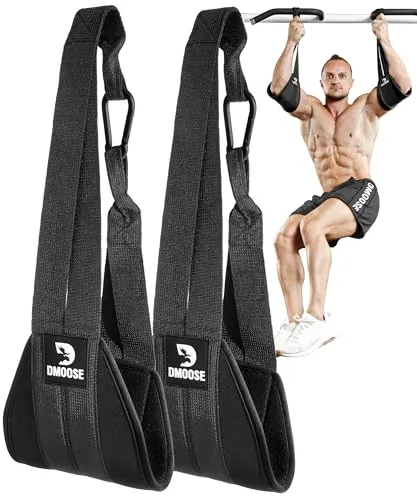
DMoose Fitness Hanging Ab Straps
- Purpose-built for hanging leg raises, knee raises, and twists.
Comparison
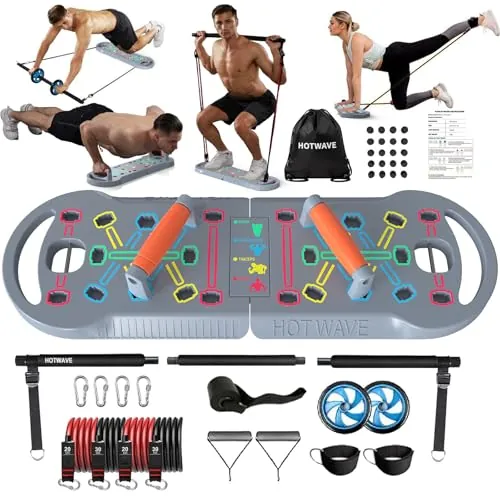
DMoose Fitness Hanging Ab Straps are a specialized accessory for supported hanging leg raises and other pull-up-bar core exercises. The HOTWAVE Push Up Board is a broader foldable home-workout kit with push-up, band, bar, and ab roller components. Choose DMoose for focused hanging core work and more consistent build feedback; choose HOTWAVE for greater exercise variety in a portable floor-based setup.
#1 Overall Winner
Contender
Choose DMoose Fitness Hanging Ab Straps if you own a secure pull-up bar and want a compact, comfortable tool for hanging leg raises. Choose the HOTWAVE Push Up Board if you need a portable starter kit for push-ups and band exercises. DMoose is more specialized and better supported by durability feedback; HOTWAVE is more versatile.
Overall winner
Depends on your needs
| Feature | DMoose Fitness Hanging Ab Straps | HOTWAVE Push Up Board Fitness | Winner |
|---|---|---|---|
Primary role |
Hanging core-training straps |
Foldable push-up and resistance-training kit |
Depends |
Core training |
Hanging leg raises, knee raises, twists |
Includes ab roller wheels and floor-based options |
DMoose Fitness Hanging Ab Straps |
Exercise variety |
Focused on hanging movements |
Push-up board, bands, bar, straps, and roller components |
HOTWAVE Push Up Board Fitness |
Required setup |
Compatible pull-up bar or multi-gym required |
Floor setup; door buckle included |
HOTWAVE Push Up Board Fitness |
Build feedback |
Frequently described as sturdy and well made |
Mixed reports, including board breakage |
DMoose Fitness Hanging Ab Straps |
Comfort |
Padded elbow support |
Ergonomic handles, though some hand discomfort is reported |
DMoose Fitness Hanging Ab Straps |
Adjustability |
Adjustable hanging fit |
Band-based intensity options and multiple board positions |
HOTWAVE Push Up Board Fitness |
Small-space storage |
Very compact pair of straps |
Foldable kit with drawstring bag |
Tie |
Portability |
Lightweight straps |
Foldable kit intended for travel |
Tie |
Safety considerations |
Secure bar compatibility and carabiner placement matter |
Board integrity and band recoil require attention |
DMoose Fitness Hanging Ab Straps |
Price supplied |
$22.52 |
$40.55 |
DMoose Fitness Hanging Ab Straps |
Best buyer |
Existing pull-up-bar owner focused on hanging abs |
Beginner or traveler wanting varied home workouts |
Depends |
DMoose supports a highly specific training task: performing hanging core exercises while the padded straps take pressure away from maintaining a direct bar grip. It is best used as an addition to a pull-up bar or multi-gym. HOTWAVE has a wider training role, combining floor-based push-up positions with resistance-band, bar, ankle-strap, and ab-roller components. This makes HOTWAVE more useful for varied general home sessions, while DMoose is more effective when hanging leg raises are already a key part of the programme. Neither replaces good setup, controlled movement, and an appropriate training progression.
Both products can contribute to bodyweight-focused strength training, but in different ways. DMoose targets the core through hanging leg raises, knee raises, and twists, with padded straps intended to improve comfort during those movements. HOTWAVE offers broader upper- and lower-body exercise possibilities through push-up positions, bands, the detachable bar, and ankle straps. For a focused hanging-core accessory, DMoose is the better fit. For a beginner-level or light home strength routine with more movement options, HOTWAVE has the advantage, provided its components are inspected and used carefully.
Neither product is a dedicated cardio machine. HOTWAVE has more potential for circuit-style sessions because its push-up board, bands, and accessories can be combined into continuous home workouts, but the supplied information does not establish a specific conditioning performance benefit. DMoose is primarily for controlled hanging core sets and is less suited to cardio-focused training. Choose HOTWAVE only if workout variety is your main route to creating a higher-tempo bodyweight routine.
HOTWAVE has limited relevance to mobility because its bands and ankle straps can be incorporated into gentle range-of-motion or warm-up work, although the supplied data does not detail specific mobility programming. DMoose is not intended as a stretching or flexibility tool; its stated role is hanging core exercise. Neither is a dedicated yoga, pilates, or mobility product, so buyers seeking those uses should consider a purpose-built option.
For its stated purpose, DMoose performs more convincingly as a dedicated hanging-core accessory. The listed padded straps, steel carabiners, and compatibility with pull-up bars align closely with leg-raise use, while reviews repeatedly mention stable attachment and comfortable support. HOTWAVE performs across more exercise categories because of its board and attachments, and users often find it effective for convenient home sessions. However, reports of platform failure and variable component quality reduce confidence for demanding use. DMoose is the more dependable specialist; HOTWAVE is the broader but less consistent multi-use option.
HOTWAVE provides more ways to structure a general home routine because it includes push-up positions, bands, a bar, ankle straps, a door buckle, and roller components. Its foldable format can reduce the friction of setting up a session in a small room or while travelling. DMoose offers less variety but can be a useful progression tool for users with a pull-up bar who want to add hanging core work without relying solely on forearm grip. Beginners may find HOTWAVE easier to incorporate initially, whereas DMoose better serves a more specific hanging-exercise goal.
DMoose supports resistance through bodyweight during hanging core movements, with straps designed to support the upper arms while users perform controlled leg or knee raises. Its usefulness depends on a stable pull-up bar and the user’s ability to control the movement. HOTWAVE offers more strength-training variation through fixed push-up positions and supplied resistance bands, including stated 20 lb and 30 lb band pairs. The board’s fixed handle layout may limit individual positioning, and the reported board failures mean it is sensible to inspect it before loading it heavily.
HOTWAVE is more adaptable for cardio-style circuits because several included attachments can be used in a compact, continuous bodyweight session. That said, the supplied information does not provide resistance tracking, pace data, or other dedicated conditioning features. DMoose is designed for sets of hanging core exercises rather than sustained cardiovascular work. For users whose priority is conditioning, neither is a dedicated solution, although HOTWAVE is the more versatile accessory for mixed circuits.
HOTWAVE has a modest advantage for warm-up and mobility-oriented use because the included bands and ankle straps may add variety beyond push-ups. The supplied data does not provide details on stretch resistance, mobility instructions, or range-of-motion outcomes, so this should not be treated as a dedicated flexibility system. DMoose is substantially more limited here, as its specified use is hanging core training rather than stretching, yoga, or pilates practice.
Both products require sensible setup and inspection. DMoose should only be used on a secure, compatible pull-up bar or multi-gym, within its listed 330 lb maximum weight recommendation. Buyers should also consider protecting painted bars because one review notes that the metal carabiners may scratch a coating. HOTWAVE includes resistance bands, carabiners, a door buckle, and a board, so users should check attachment points, component condition, and door-anchor placement before each session. Supplied feedback includes concerns about band recoil and boards snapping, making damaged or worn components inappropriate to use.
DMoose has a clearer comfort advantage for its intended exercise. The product specifies 5 mm elbow padding, and several reviews note that the straps are easy on the wrists, shoulders, triceps, and backs of the arms during leg raises. However, the arm sling may be too large or stiff for smaller users. HOTWAVE’s handles may help some users avoid the wrist angle of floor push-ups, but feedback includes occasional hand pain. Comfort therefore favors DMoose, assuming the strap dimensions fit the user.
Both products are designed to limit setup friction. DMoose is simple to clip onto a compatible bar, and buyers frequently mention quick installation and removal. HOTWAVE folds for storage and users often describe setup as fast, with bands that are easy to adjust. However, it has more pieces to organize and at least one review mentions difficulty fitting roller components to the bar. DMoose is easier for a single known movement pattern; HOTWAVE is easy to store but more involved to configure for its wider set of exercises.
DMoose receives more consistent stability feedback when attached to a compatible pull-up bar or rack. Its straps are described as secure and stable, but the bar itself must be properly installed and suitable for use. HOTWAVE includes anti-slip rubber pads and is described by some users as secure, yet reports of board breakage make stability more dependent on component condition and appropriate loading. DMoose is the stronger option for stable use within its narrower hanging-core role.
DMoose can reduce the need to hold the bar directly during hanging core work because the user is supported through the padded arm straps. HOTWAVE uses ergonomic push-up handles, and some reviewers say the raised handle position is more comfortable than floor push-ups. However, another reviewer still noted occasional hand discomfort. Neither product removes the need for controlled technique, but DMoose is more useful when grip fatigue is the limiting factor in hanging work.
HOTWAVE offers more adjustment in practical training terms. Its push-up board provides multiple hand locations, and the supplied kit includes resistance bands in stated 20 lb and 30 lb pairs, allowing users to change band combinations and exercise selection. DMoose adjusts to provide a secure hanging fit, but its basic function remains the same: supported hanging core movements. Choose HOTWAVE for more routine variation; choose DMoose for a simpler, dedicated setup.
Both products work well in limited spaces. DMoose is exceptionally compact at a listed 0.27 kg and can be stored in a small drawer or gym bag, although it relies on a pull-up bar that occupies its own space. HOTWAVE folds down and combines several accessories into one kit, reducing the need to buy multiple separate tools. For the smallest possible accessory footprint, DMoose wins. For more exercise options without building a large equipment collection, HOTWAVE is highly practical.
Neither product is likely to create the continuous mechanical noise associated with cardio machines. DMoose is quiet apart from normal carabiner contact with the bar. HOTWAVE can support quiet indoor workouts, as noted by one reviewer, though bands, attachments, and the board may create minor setup or contact noise. Floor surface and training style will influence noise more than either product’s basic design.
DMoose has the stronger build case in the supplied data. Its rip-resistant nylon construction, steel carabiners, and 5 mm padding are consistent with its simple hanging-strap function, and buyer feedback commonly calls the product sturdy and well made. HOTWAVE’s ABS board and bundled accessories provide useful variety, but quality feedback is mixed. Some reviewers find the board sturdy, while others report breakage or a cheaply made feel. The bag is also a reported weak point. DMoose is the safer choice where construction consistency is the priority.
DMoose is described as built for regular use, and reviewers commonly report durable, dependable-feeling straps. Its limited number of components also means fewer parts to assemble, store, or wear. The main practical concern is potential bar scratching from the metal carabiners rather than strap failure. HOTWAVE has more parts and therefore more potential points of wear, with reports of a ripped bag, fit issues with roller assembly, and boards that have snapped or arrived damaged. Its long-term durability is less predictable from the supplied evidence.
DMoose requires minimal upkeep: inspect the nylon straps, padding, stitching, and carabiners, and store them dry after use. HOTWAVE needs more routine checking because it includes bands, clips, board parts, handles, pads, and a bag. Inspect resistance tubing and carabiners for damage, confirm the board is intact, and keep components organized after each session. DMoose is simpler to maintain because it has fewer parts and no bands or detachable assembly pieces.
DMoose is very portable because it is a lightweight pair of straps with no large base or multiple attachments. It is easy to carry to a gym, but it is only useful where a compatible pull-up bar is available. HOTWAVE is also designed for portability, folding down into a travel-oriented kit with a drawstring bag. It offers more independent workout options away from a pull-up bar, although it is bulkier and the supplied bag has mixed durability feedback.
For equipment, material disclosure is the relevant comparison rather than ingredients. DMoose identifies nylon, neoprene, and alloy steel in the supplied information, along with steel carabiners and padded elbow support. HOTWAVE identifies ABS as the main material and gives a detailed included-components list, including bands, carabiners, pads, and handles. DMoose offers clearer detail around the materials of its core straps, while HOTWAVE is clearer about the contents of its kit but provides less component-by-component material detail.
DMoose is the stronger value for a buyer whose goal is hanging leg raises. Its supplied price is lower, it has a simple but relevant construction, and buyer feedback is notably positive around comfort, stability, and durability. It is not a full workout system, so its value falls if the user lacks a suitable bar or wants wider exercise variety. HOTWAVE costs more but includes a substantial bundle of accessories and can replace several entry-level tools for a beginner. Its value depends on using those components regularly and accepting the mixed durability evidence.
The supplied data gives DMoose the stronger trust case for this comparison. Its product feedback is highly consistent around the straps’ quality, stability, comfort, and usefulness for hanging core work. HOTWAVE has many satisfied users who value its versatility and portability, but its feedback is less consistent because of reports involving board breakage, cheap-feeling construction, and bag durability. Neither product has supplied third-party testing, certification, or warranty detail that would allow broader conclusions beyond the listing and buyer feedback.
Both products have a supplied 4.5/5 star rating and thousands of reviews, indicating substantial buyer engagement. DMoose has the more consistently positive review pattern: users frequently praise comfort, strong clips, easy installation, stable support, and usefulness for leg raises. Repeated concerns focus on strap length, bar clearance, fit for smaller users, and possible bar scratching. HOTWAVE also receives praise for portability, compact storage, exercise variety, and beginner suitability. However, feedback is more divided, with reports of fixed-feeling positions, assembly friction, a weak bag, and broken boards.
DMoose’s core claims are relatively well aligned with the supplied specifications and buyer feedback. The listing identifies nylon, steel carabiners, padding, pull-up-bar compatibility, and a listed maximum weight recommendation, while reviews support ease of attachment and comfort for leg raises. The claim of enhanced core isolation should be understood as intended use rather than independently verified training evidence. HOTWAVE’s component list supports its versatility claim, but broad statements about replacing gym equipment or improving exercise efficiency are not independently substantiated by the supplied data. Its mixed durability feedback also limits confidence in broad performance claims.
DMoose Fitness Hanging Ab Straps win this comparison for buyers seeking a reliable, focused hanging-core accessory. Their main strength is a simple, padded nylon-and-steel design that is well matched to leg raises and supported by consistently positive feedback on stability, comfort, and apparent durability. Their main limitation is that they require a secure pull-up bar and may not fit every user equally well.
HOTWAVE Push Up Board Fitness is the better choice only when training variety is the main priority. It offers a useful collection of portable push-up and band-training accessories, but its main limitation is inconsistent build feedback, including reports of board and bag failures. Choose based on whether specialized hanging core work or broader home-workout flexibility matters more.
Overall winner
Depends on your needs
The better choice depends on the workout you want to prioritize. DMoose is the more focused option for hanging leg raises and similar core work on an existing pull-up bar. HOTWAVE is more suitable for users who want a foldable kit for push-ups, bands, and varied home sessions, but its durability feedback is less consistent.
DMoose is the clear fit for hanging leg raises because it is specifically designed as a pair of padded hanging straps with steel carabiners. HOTWAVE includes ab roller wheels and other attachments, but the supplied kit details do not make it a substitute for a hanging leg-raise setup.
Not directly. HOTWAVE can provide varied floor-based push-up, band, and accessory exercises, whereas DMoose supports hanging core movements from a pull-up bar or multi-gym. A user wanting both floor-based training variety and hanging leg raises may find the products complementary rather than interchangeable.
Both products are space-efficient. DMoose takes very little room but requires a pull-up bar already installed in the space. HOTWAVE folds away and includes several attachments, so it can cover more exercise types without adding multiple separate accessories. Choose based on whether existing bar access is available.
HOTWAVE is generally the more accessible starting point for beginners because its push-up board, bands, and guide support a range of lower-complexity floor exercises. DMoose is straightforward to attach, but hanging movements require a secure bar setup and enough control to use the straps safely.
The supplied details specify 5 mm elbow padding, and many reviews describe the straps as comfortable on the arms and shoulders during sets. Fit is not universal: smaller users have reported that the arm slings can feel overly large or stiff, so individual body size matters.
Yes. Some buyers describe the board as sturdy and suitable for regular use, but the supplied review overview also includes reports of boards snapping or arriving broken. There is also a report of the carrying bag ripping on first use. Inspect components before use and follow the supplied setup guidance.
DMoose offers stronger value for a buyer who specifically needs hanging core support and already owns a compatible bar, especially given its lower supplied price and more consistent quality feedback. HOTWAVE can represent better value for someone who will use its board, bands, bar, and other included components regularly.
Check our rankings and expert guides to find the best fitness products for your goals.